

America 250, Juneteenth, and the Unfinished Republic
By Jim Embry
As communities throughout Kentucky and across the nation commemorate Juneteenth and prepare for the 250th anniversary of American independence, we are presented with a chance to ask a more direct question: What are we celebrating, and why?
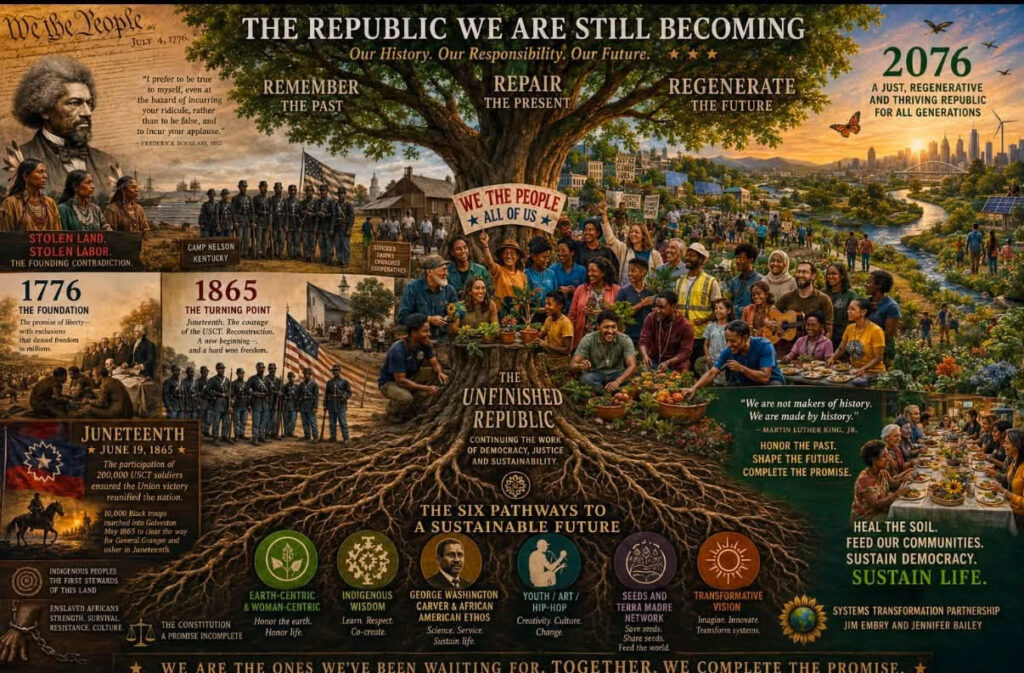
July 4, 1776, signifies the birth of the American Republic. Juneteenth, June 19, 1865, marks one of its most important transformations. The former commemorates the Declaration of Liberty; the latter represents a decisive step toward fulfilling that promise.
Together, these commemorations present a more comprehensive narrative of American history.
In 1852, Frederick Douglass delivered his unforgettable speech, “What to the Slave Is the Fourth of July?” Douglass honored the ideals of the Declaration of Independence while exposing the painful contradiction between those ideals and slavery. His challenge still speaks to us today.
This contradiction extended beyond the institution of slavery.
The United States emerged as a republic built upon two foundational injustices: the dispossession of Indigenous peoples from their lands and the exploitation of enslaved Africans for their labor. Put simply, the nation grew on stolen land and stolen labor.
At the nation’s founding, freedom was not distributed equally. Native peoples were excluded from citizenship, enslaved Africans were denied both freedom and legal personhood, women lacked political rights, and even many white men without property were unable to fully participate in public life.
Acknowledging these historical realities does not diminish the significance of America.
It helps us understand the republic we inherited.
Nearly ninety years later, the Civil War forced the nation to confront that contradiction.
A pivotal moment occurred when nearly 200,000 Black men and women enlisted in the Union Army and Navy. Many were formerly enslaved or had been farmers only months prior, while others originated from free Black communities, including thousands from Kentucky.
Kentucky was the second-largest contributor of Black soldiers to the Union Army, which established Camp Nelson as one of the Commonwealth’s and the nation’s most significant landmarks in the history of American freedom.
These individuals seeking freedom exchanged agricultural tools for rifles and left corn and hemp fields to serve on battlefields.
They fought not only to preserve the Union but also to secure freedom for themselves, their families, and future generations.
Their service became a federally sanctioned armed struggle for freedom, redefining the Civil War as a fight not only to save the nation but also to remake it.
Their courage altered the course of history.
More than 23,000 Black Kentuckians served in the United States Colored Troops, with many training at Camp Nelson. Nationally, Black soldiers and sailors contributed to Union victory, the abolition of slavery, and the establishment of the Reconstruction Amendments that expanded American citizenship.
Juneteenth, therefore, should be recognized as more than simply Freedom Day, Emancipation Day, or Jubilee Day.
It should also be commemorated as Reunification Day.
The defeat of the Confederacy preserved the United States as one nation. Had the Confederacy succeeded, North America might have remained divided, and American—and perhaps world—history would have been profoundly different.
As America approaches its 250th anniversary, it is important to resist the inclination to choose between patriotism and honesty.
It is possible to celebrate the Declaration of Independence while simultaneously acknowledging its limitations.
We can honor the founders while also honoring those who expanded freedom: abolitionists, suffragists, civil rights leaders, and especially the nearly 200,000 Black soldiers and sailors who helped create what historian Eric Foner has called America’s “Second Founding.”
History imparts an additional lesson. Democracy requires active maintenance. Similar to fertile soil, democracy must be intentionally cultivated.
Every generation inherits a field prepared by those who came before, and every generation decides whether that field will become richer or poorer for those who follow.
America 250 is our generation’s test of that commitment.
July Fourth serves as a reminder of the nation’s founding promise.
Together, these commemorations prompt a question that extends beyond mere celebration:
What kind of republic are we cultivating for the Americans who will gather in 2076 to celebrate our nation’s 300th anniversary—and what will we do now to help shape that future?
That answer may become the most important legacy of America 250.
Jim Embry, a 2023 James Beard Foundation Leadership Award winner and Black Appalachian Storytellers Fellowship winner, is a lifelong community activist, historian, and photographer; he lives on a family farm in Madison County. He can be reached at embryjim@gmail.com.